
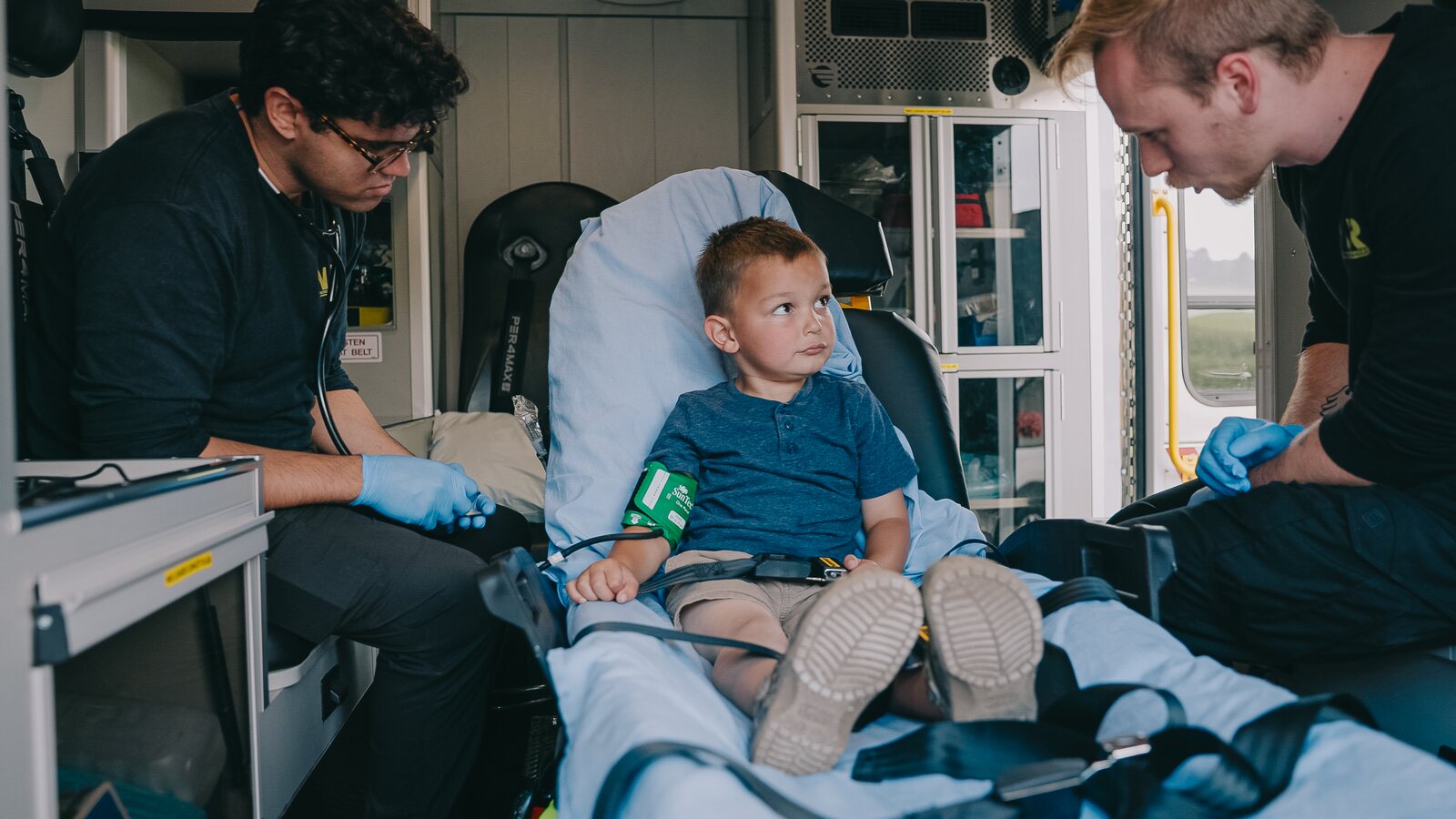
A 6-pound newborn and a 250-pound adult cannot be transported the same way. Adult protocols, equipment, and dosing don't scale down to fit a smaller body.
A 6-pound newborn and a 250-pound adult cannot be transported the same way. Adult transport protocols, adult equipment, adult drug dosing — they don't scale down. When a pediatric or neonatal patient needs to be moved between facilities, the margin for error shrinks dramatically, and the clinical team in the back of the ambulance needs to be trained, equipped, and practiced for exactly that patient — not adapting adult care to fit a smaller body. This is one of the biggest gaps in rural EMS, and it's one of the reasons Northwest Rescue prioritizes specialty pediatric and neonatal transport as a core service.
Why pediatric and neonatal transport is different
The shorthand the EMS world uses — "pediatric is different" — is easy to say and hard to actually do. Here's what it means in practice: Smaller patients decompensate faster. A child's physiologic reserve is smaller than an adult's. They can compensate a respiratory or circulatory problem looking relatively stable — right up until they can't, and then the crash is rapid. Transport teams need to anticipate deterioration, not react to it. Drug dosing is weight-based, not dose-based. Every medication is calculated per kilogram. A math error in a critical drip can be catastrophic. Crews working pediatric patients need to run dosing calculations quickly and confidently under pressure — and confirm them. Airway anatomy is different. Pediatric airways are smaller, more anterior, and more prone to swelling. The equipment needed to manage them is a different size range entirely. A good specialty team carries the full size spectrum, not just "adult" kit. Thermoregulation is critical. Infants, especially neonates, lose heat rapidly. Temperature management isn't a nice-to-have — it's a core clinical intervention. Cold stress affects glucose, oxygenation, and metabolic stability all at once. Parents are part of the patient. In pediatric and neonatal transport, the family is a clinical consideration. Good crews know how to communicate with parents during the worst hours of their lives while still executing high-acuity care.
Neonatal transport: a category of its own
Neonatal transport — patients from birth to 28 days — is its own clinical world. Neonates require:
- Isolettes (transport incubators) for temperature, humidity, and oxygen control
- Specialized ventilators that can deliver the small tidal volumes and precise pressures neonatal lungs need
- Heated humidified high-flow oxygen — a technology Northwest Rescue was among the first in our region to bring into the transport environment
- IV pumps accurate to a tenth of a milliliter because fluid margins are that tight
- Glucose monitoring because neonatal hypoglycemia presents quietly and hurts fast
None of that equipment lives on a standard ambulance. None of it gets used well by a crew that doesn't train on it regularly. A hospital transferring a neonate — from a community birthing center to a Level III or IV NICU, for example — needs a team that arrives with the right equipment and the muscle memory to use it under pressure.
Pediatric transport: a huge range on one label
Pediatric transport — roughly 29 days through 17 years — covers an enormous range of ages, weights, and clinical scenarios. A 4-year-old in status asthmaticus, a 12-year-old with a traumatic brain injury, an 8-month-old with bronchiolitis, a 15-year-old post-cardiac arrest — all of these are "pediatric" transports, and every one of them needs different gear, different dosing, and different clinical priorities. A specialty team doesn't just mean "we brought the pediatric bag." It means the crew has the training and the practice to shift from one age band to another without losing ground.
What to look for in a specialty transport team
If you're a discharge planner, case manager, charge nurse, or pediatrician arranging a transfer, here's what separates a true specialty service from a generalist:
- Certifications on every crew member. PALS (Pediatric Advanced Life Support) and NRP (Neonatal Resuscitation Program) at minimum for any clinician running a pediatric or neonatal transport. Critical care paramedics carry additional credentialing on top of that.
- Dedicated pediatric and neonatal equipment on the truck — not borrowed, not improvised. Isolette, pediatric-specific ventilator settings, full pediatric airway and drug kits.
- Clinical protocols built for the age band. Adult protocols adapted on the fly don't cut it. A good service has written, rehearsed protocols for pediatric respiratory failure, pediatric sepsis, neonatal resuscitation, and the common clinical scenarios that show up on transfer.
- Experience that's ongoing, not historical. Pediatric transport is a skill that decays without repetition. A good service runs these calls often enough that the team stays sharp.
- Communication with the receiving facility before wheels roll. The receiving NICU or PICU should know exactly what's coming, what's running, and what the clinical picture looks like before the patient arrives.
Why time matters more here
In adult critical care transport, minutes matter. In pediatric and neonatal transport, minutes matter more. Small patients tolerate delay poorly. A neonate with respiratory failure cannot wait for an alternative team to be called if the first service can't handle the call. A pediatric patient with evolving sepsis will be sicker on arrival to a tertiary center than they were at the community hospital — that's the nature of the clinical course, not a reflection on anyone's care. The fastest path to the right level of care is calling a team that can actually handle the patient, not the team that happens to be down the road. That's the real calculus behind specialty transport: the right crew on the first call is faster than the wrong crew on the first call followed by the right crew on the second.
How Northwest Rescue approaches this work
Specialty pediatric and neonatal transport is one of our core priorities — not because it's glamorous, but because it's exactly the kind of gap rural patients fall into when a service isn't specifically built for them. Our critical care program carries:
- Full neonatal transport equipment, including isolette capability
- Pediatric-specific ventilators with the settings small lungs require
- Heated humidified high-flow oxygen in the transport environment (one of the first services in our region to bring this into a rig)
- PALS- and NRP-credentialed critical care paramedics
- Continuous crew training on pediatric and neonatal protocols
We run these calls across our multi-regional coverage area — from Harvard through Rockford and into the Southern Wisconsin region — and we coordinate directly with sending and receiving facilities so nothing gets lost in the hand-off. If you want the broader picture of how interfacility and critical care transport works in general, our explainer on 911 vs. Interfacility Transport walks through the full landscape.
What to expect when you call us for a pediatric or neonatal transport
- One phone call, one team. Our dispatch handles the whole coordination — receiving facility contact, bed confirmation, arrival ETA updates. You don't have to chase us.
- We confirm the equipment and crew before wheels roll. If the patient needs a full neonatal isolette, the rig that comes is the rig that has it.
- We communicate during the transport. If anything changes en route clinically, the receiving facility knows before the ambulance pulls up.
- We stay for hand-off. Transfer of care is a clinical event, not a handshake. Our crew completes the hand-off with the receiving team and gets the next steps documented.
Bottom line
Pediatric and neonatal patients are not small adults. The equipment, the dosing, the protocols, and the clinical instincts all shift when the patient is under 50 pounds — and they shift again when the patient is under 5. A specialty transport team isn't a marketing distinction. It's a patient safety distinction. If your facility needs a specialty pediatric or neonatal transport in northern Illinois or southern Wisconsin, Northwest Rescue is built for exactly this work.
Related reading
- 911 vs. Interfacility Transport: What's the Difference and When Do You Need Each?
- When to Call 911 vs. When to Drive to the ER: A Practical Guide
- How to Become an EMT in Illinois: The 2026 Step-by-Step Guide
- EMT vs. Paramedic vs. Critical Care Paramedic: What's the Difference and How to Choose
Need a pediatric or neonatal transport? Contact our dispatch team and we'll coordinate the move.