
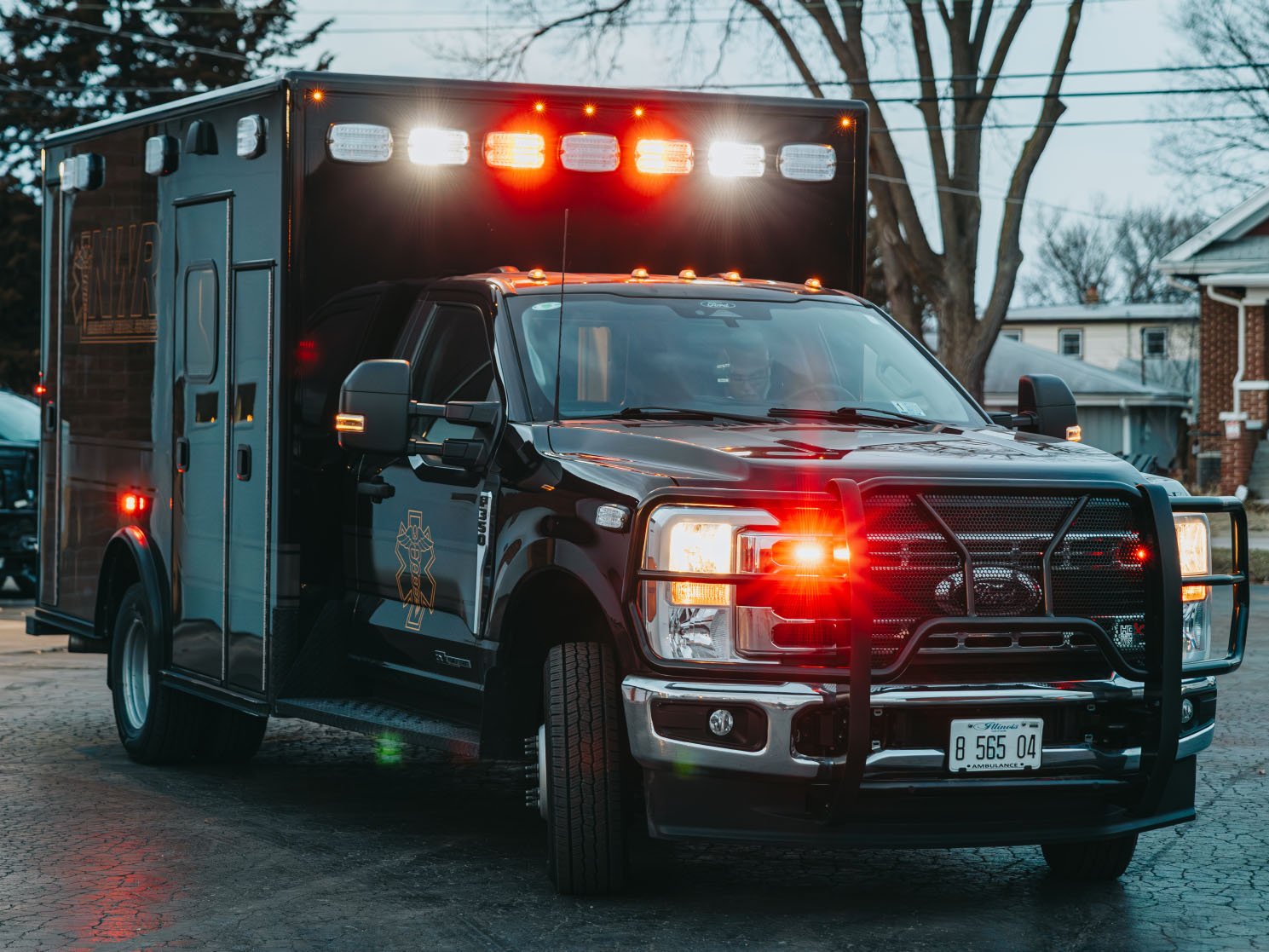
Distance, roads, and staffing shape rural EMS response times. Here's how station placement, posting, scheduling, and mutual aid win back minutes.
A call comes in from a farmhouse eleven miles outside town. The caller is a daughter; her father is short of breath and gray in the face. Between that kitchen and the nearest ambulance bay sit two county highways and a stretch of gravel that turns soft after rain. Once the tones drop, that distance is not negotiable. Everything that shortens the wait was decided weeks earlier: where the ambulance was parked, who was on the schedule, and who takes the call when the closest unit is committed. This is how that work gets done.
Response time is the first number people ask about and the most often misunderstood. Northwest Illinois EMS response times are shaped less by how fast a driver is willing to go than by structural facts: how far apart the addresses are, how many units are in service at three in the morning, and how long the last crew has been tied up at a hospital forty minutes out.
Northwest Rescue has worked in this environment since 2013, when Ryan Kurth founded the company. Our stations in Harvard, Rockford, Loves Park, and Ottawa, Illinois, and Delavan, Wisconsin, cover Winnebago, McHenry, and LaSalle counties. What follows are the levers that actually change minutes.
What A Response Time Actually Measures
Most people hear "response time" and picture the drive. The drive is one piece.
- Call processing. From the 911 center answering to a unit being assigned, while dispatch confirms the location and picks the resource.
- Chute time. Dispatch to wheels rolling. Short for a posted crew, longer for one asleep at 0300.
- Travel time. The drive, governed by distance and road conditions more than by the driver.
- Transport interval. The trip to the hospital. It never shows up in a response-time statistic, but it decides when that ambulance is free for the next call.
Only part of that chain belongs to the ambulance service.
Why Rural Geography Works Against The Clock
Distance is the obvious problem, and not the only one. Rural road networks are sparse and indirect. A patient two miles away as the crow flies can be nine by road. Addresses are harder to find: long unlit driveways, similar route numbers, mailboxes far from the house. Research on rural emergency care consistently finds average response intervals already past the eight- to nine-minute benchmarks urban systems use. That gap is a function of the map.
Staffing compounds it. Much of rural America runs on volunteer agencies, and volunteer participation has declined nationally for years while costs climb. Fewer staffed units means the second call of the morning waits on a truck from farther out. We covered that in Rural EMS: Why Coverage Matters in Small Towns.
Where Longer Transports Come Back To Bite You
Rural hospital and emergency department closures have pushed transport distances up across the Midwest. Studies of closure-affected communities measured real increases in transport and total activation times afterward.
A longer transport does not slow the call it belongs to. It slows the next one. Every extra minute driving to a farther hospital, plus the wait to hand off, is a minute that unit is unavailable. A large system absorbs that. A rural system gets a hole.
So we treat unit availability, not raw speed, as the target. Keeping scheduled and interfacility work from eating emergency capacity is part of it, a distinction laid out in 911 vs. Interfacility Transport.
Where We Put Stations, And Why
Station placement is the highest-leverage decision an ambulance service makes, and close to permanent. A truck cannot outrun a bad location. The questions are always the same:
- Where does call volume actually originate, by address and hour?
- What does the road network allow — which routes move, which bottleneck, which flood?
- Which areas are already covered by a capable local agency, and which are genuinely thin?
- Can a crew live, restock, and rest there? A station nobody can staff is not coverage.
Harvard, Rockford, Loves Park, Ottawa, and Delavan were each chosen against that list. The reasoning is in Why We Serve Harvard, Rockford, Loves Park, and Ottawa.
Moving Units Before The Call Comes In
Stations are fixed. Ambulances are not. Repositioning in-service units through the day — posting, or system status management — is how a service covers ground it has no building on.
The principle is simple. When one unit goes on a call, the others shift to fill the space it left, so the next call is not answered from the far corner of the district.
The execution is not. Over-posting burns fuel and grinds crews down. Under-posting leaves holes at the worst hour. That balance gets judged continuously by people watching the board. It is one of the few real-time levers that shortens response.
Building The Schedule Around Real Demand
Emergency call volume is not flat. It climbs through late morning, peaks in the afternoon and early evening, and thins overnight. It moves with season, weather, and the local calendar.
Scheduling to that curve instead of to convenient blocks takes discipline: overlapping shift changes so no district goes uncovered during handoff, adding capacity at predictable peaks, and staffing for the surge you expect, not the average you got. It also means taking fatigue seriously. A tired crew is slower and less safe, which puts shift design and recruiting at the center of response performance — work that runs through careers as much as operations.
Sending The Right Unit The First Time
Tiering matters more in rural systems because there is less to spare. Sending an advanced life support (ALS) unit on a call a basic life support (BLS) crew can handle takes that truck off the board for an hour. Sending BLS to a call that needs ALS costs the patient time on an intercept. Good dispatch triage and a clear ALS and BLS mix shorten the interval that matters: time to the care the patient needs. ALS vs. BLS: When Each Is Right walks through it.
Mutual and automatic aid sit alongside it. Written closest-unit agreements with neighbors and fire departments mean the nearest capable ambulance responds regardless of whose name is on the door — the most effective structural fix rural EMS has, and the basis of our 911 emergency response work.
Weather, Roads, And What Nobody Controls
Northern Illinois and Southern Wisconsin get snow, freezing rain, river-bottom fog, flooding, and harvest equipment on two-lane roads. None of it can be eliminated. All of it can be planned for.
- Preparing vehicles and tires ahead of a forecast, not during it.
- Pre-staging units on the far side of routes that historically close.
- Knowing which crossings and low spots fail first, and routing around them by default.
Weather is the clearest example of the theme running through all of this: the minutes are won before the call, not during it.
Frequently Asked Questions
What Is A Good Ambulance Response Time In A Rural Area?
There is no single correct number, and any agency quoting one without context should be questioned. Urban systems commonly benchmark against eight- to nine-minute targets, measured as a percentage of calls rather than an average. Rural averages routinely run longer because of distance and road networks, which is geography, not performance failure. Better questions are whether a staffed, properly equipped unit is consistently available, whether mutual aid fills gaps reliably, and whether the agency measures its own intervals honestly and improves them.
Why Does It Take Longer For An Ambulance To Reach A Rural Address?
Three reasons stack up. Distance is the first: rural service areas cover far more square miles per staffed ambulance than suburban ones. The road network is the second, since indirect routes, unpaved surfaces, rail crossings, and seasonal closures add travel time that straight-line distance hides. The third is unit availability. With fewer ambulances in service across a large area, a call that arrives while the nearest crew is already transporting gets the next-nearest unit, which may be considerably farther out. Longer hospital transport distances make that worse.
Does The Closest Ambulance Always Get Sent?
Usually, but not automatically. Dispatch sends the closest available unit capable of handling the call, so proximity and capability both count. If the nearest ambulance is a basic life support crew and the call clearly needs advanced life support, dispatch may send both or arrange an intercept. Closest-unit response across agency lines depends on mutual aid agreements being in place and on dispatch centers sharing unit locations. Where those agreements exist and are honored, response improves for everyone in the coverage area.
What Can I Do To Help An Ambulance Find Me Faster?
More than you would think. Post visible, reflective address numbers at the road and again at the house if the driveway is long. Turn on exterior lights at night and, if someone can be spared, send them to the end of the driveway to flag the ambulance in. Secure dogs before the crew arrives. Unlock the door. Tell the dispatcher about gates, unmarked lanes, or which of two similar driveways to use, and stay on the line. On a rural address, those steps save real minutes.
Does A Private Ambulance Service Respond To 911 Calls?
Yes. In Illinois and Wisconsin, licensed private ambulance providers can and do serve as the 911 response agency for a municipality, township, or fire protection district under contract, and they operate under the same state licensing and regional medical direction as any other provider. Northwest Rescue provides 911 emergency response alongside basic life support, advanced life support, critical care, pediatric and neonatal transport, and event coverage. The structure matters less to the patient than the staffing, equipment, and medical oversight behind the truck that shows up.
How Does Winter Weather Affect Response Times In Northern Illinois?
Winter creates the worst combination in EMS: call volume goes up while travel speed goes down. Snow, ice, and freezing rain slow every unit on the road at the same time falls, crashes, and cardiac events increase. Rural roads are typically plowed after primary routes, so outlying addresses stay difficult longer. Agencies plan for it by preparing vehicles ahead of forecasts, pre-staging units near areas that historically become unreachable, adding capacity during major storms, and routing around known problem crossings by default rather than discovering them mid-call.
Related reading
- Rural EMS: Why Coverage Matters in Small Towns
- Why We Serve Harvard, Rockford, Loves Park, and Ottawa
- 911 vs. Interfacility Transport, Explained
- When to Call 911 vs. Drive to the ER
- Average Ambulance Response Time in Illinois (2026) (coming soon)
If your community or facility needs coverage, start with a conversation. We would rather talk through your geography, call patterns, and existing agreements than quote a number that means nothing without context. Contact Northwest Rescue and we will tell you what we can realistically do.