An EMT ride along shows you what ambulance work really feels like. Here is who it suits, how to apply at Northwest Rescue, what to bring and how to act.
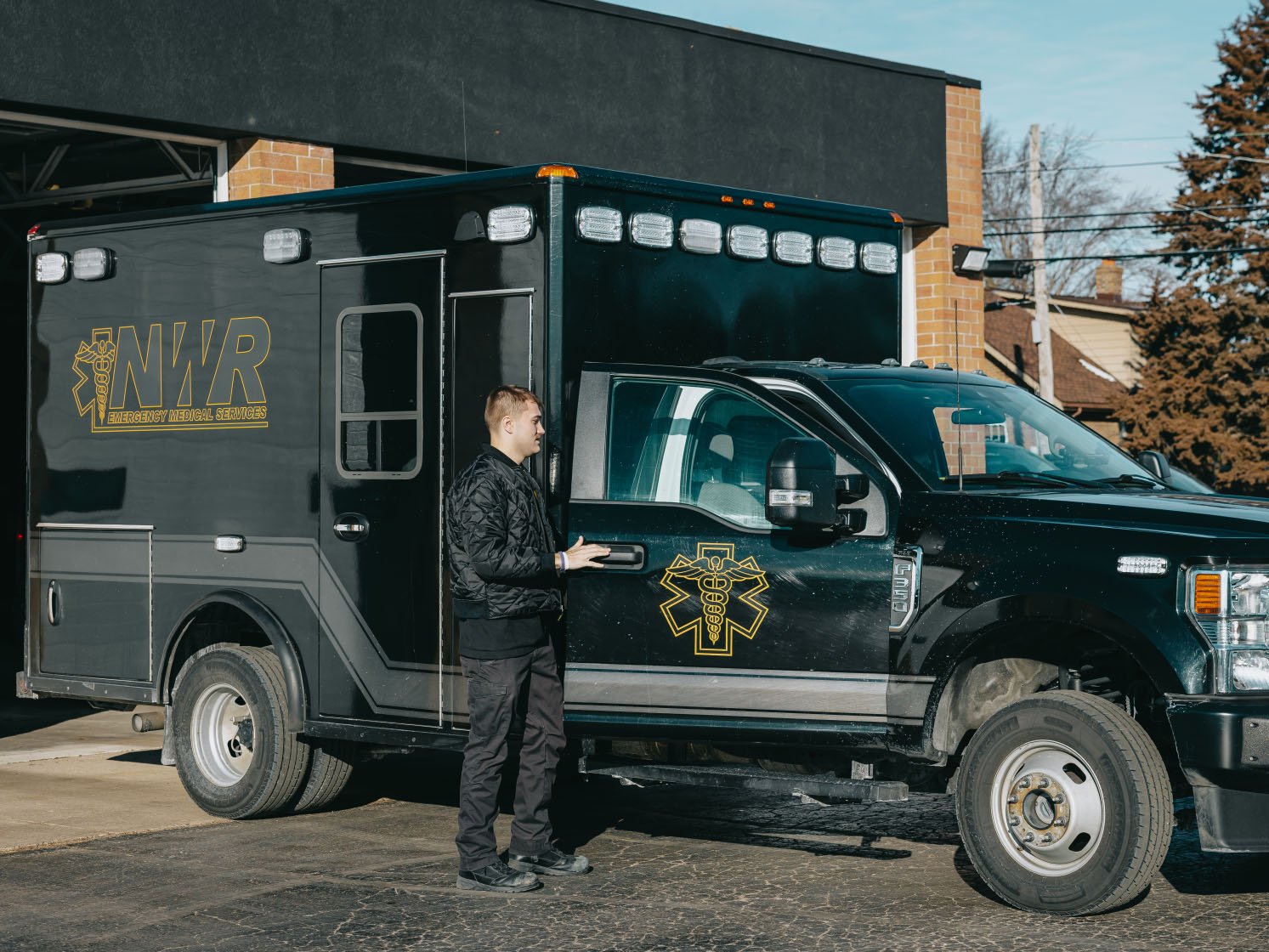
It is 6:45 a.m. and you are standing in a station bay holding a coffee you are too nervous to drink. The crew is checking the rig (airway bag, monitor, drug box, oxygen) and someone points you to where you will sit. Nobody knows what the next twelve hours hold. That is the point.
An EMT ride along is the quickest way to answer a question a lot of people are quietly asking: is this work actually for me? Classroom hours teach you protocols. A shift on an ambulance teaches you what the job feels like: the waiting, the sudden change of pace, the weight of a stair chair on a narrow staircase.
Northwest Rescue has run emergency and interfacility transport across northern Illinois and southern Wisconsin since 2013. We work out of stations in Loves Park, Rockford, Harvard and Lake in the Hills in Illinois, and Delavan in Wisconsin. Observers see a real cross-section of that work, from 911 response to BLS and ALS transport to the interfacility side of EMS that rarely shows up in recruiting videos. Here is what a ride-along with us involves, who it suits, how to apply, what to bring and how to carry yourself.
What an EMT ride along actually is
A ride-along, sometimes called an observer shift or third-rider shift, puts you on an ambulance as a non-participating observer for a set block of time. You are there to watch, not to work. Observers do not perform patient care, lift patients or handle equipment unless a crew member hands you something. Every EMS agency draws that liability and patient-safety line in roughly the same place.
It is also not a clinical rotation. Students completing program hours ride under a school affiliation agreement, with a preceptor signing off on their skills. That is different paperwork entirely, so tell us up front which one you need.
What you see depends on the day. Some shifts run call after call. Others are quiet, and you spend the hours watching rig checks, restocking and the way a crew stays ready without a call coming in. Our day in the life of a 24-hour shift shows that rhythm well.
Who gets the most out of a shift
The people who get the most from an observer shift are usually the ones considering EMS as a career. You want to know whether the reality matches the idea before you pay for a course, and nothing answers that faster.
Current EMT students get something different. You already have the vocabulary but not the context, and watching experienced providers is where protocol starts turning into judgment. Certified EMTs who are weighing an employer can learn more from how a company treats its crews and maintains its trucks than from any interview. Nursing and pre-medical students benefit too, because what happens before the ED doors is directly useful to their own practice.
Still mapping out licensure? Start with our guide to becoming an EMT in Illinois, then request a ride-along.
How to apply
Requirements vary between agencies and change over time, so treat this as the general shape and confirm the specifics with us.
- Reach out and ask. Use our contact page or careers page. Tell us who you are, why you want to ride, whether you are a student or a prospective applicant, and which station works for you.
- Have a short screening conversation so we understand your background and can answer your questions first.
- Complete the paperwork. Expect a liability waiver and a confidentiality agreement at minimum, and ask what the current packet includes.
- Provide the required documents. Agencies commonly ask observers for photo ID and proof of immunizations, and sometimes a background check or TB screening.
- Schedule a shift. Availability depends on station and crew capacity, and flexibility gets you scheduled sooner.
- Confirm your report time and location. Arrive early enough to be introduced before rig checks start.
Minimum age, insurance and documentation requirements are set by policy and can change. Do not assume another agency's rules apply here; ask us in writing.
What to wear and what to bring
Dress like you belong there without pretending to be staff. Plain, dark, professional clothing works best, with no logos or patches that could make a patient think you are a provider. Wear closed-toe shoes with real soles, because you will be standing on wet pavement, gravel and hospital tile over the course of the day.
Bring photo ID, a watch, a pen and notebook, food and water for the full shift, a jacket that suits the season, and any medication you need. Meal breaks are not guaranteed. Leave strong cologne at home, along with anything you would hate to lose. Phones stay in your pocket during calls, and there are no photos or video at any point.
Confidentiality and how to carry yourself
Everything you see and hear on a shift is confidential. Patient names, addresses, conditions and circumstances are protected health information. You will likely sign a HIPAA-related confidentiality agreement, and it is not a formality, so do not post about your day, even vaguely.
When a crew member tells you to wait in the truck or step back, do it right away and ask why later. Scene safety decisions get made in seconds. Introduce yourself plainly as an observer, not as a student provider or an EMT. Curiosity is welcome at the station and on the drive back, but not at the bedside and not while a medic is talking to medical control. And if a patient or family would rather you were not in the room, step out. It is their right, and it is not personal.
What the day can feel like
The physical side is real. There is lifting, awkward angles, stairs, long stretches on your feet, and the particular fatigue of staying alert for hours without a call. Motion sickness also catches people off guard, since riding backward while watching a monitor is a common trigger. Eat light and tell the crew early if you start to feel it.
Some calls are hard to watch. You may see serious injury, cardiac arrest, active resuscitation or a patient who does not survive. Crews carry this professionally, but it lands differently the first time you see it. You can always tell the crew you need air and take a minute; providers with twenty years on the job have done the same. If a call stays with you afterward, that is normal. Say something to the crew or to whoever coordinated your ride.
Making the most of your shift
Pay attention to the parts that are not clinical: how the crew greets a patient, how they position themselves in a small room, how they hand off at the hospital. The medicine can be taught. The way a provider deals with people is what separates the good ones from the adequate ones.
Ask better questions, too. Instead of "what was the diagnosis," try "what were you deciding between" or "when did you know this was serious." Notice the non-emergency work as well, since a large share of EMS is interfacility transport. Understanding 911 versus interfacility transport and how ALS and BLS differ makes you a more informed candidate.
Write your notes after the shift, not during it. Keep them to themes and questions, and never include a detail that could identify a patient. Then say thank you. The crew hosted you on a working shift, and a note afterward gets remembered.
Frequently asked questions
How old do you have to be for an EMT ride along?
Minimum age is set by agency policy and insurance requirements, and it varies across EMS. Many services set the floor at 18 for general observers, and some run separate, more limited programs for younger students through a school or explorer partnership. Contact Northwest Rescue directly for our current minimum age and whether parental consent or extra documentation applies.
How long is a typical ride-along shift?
That depends on the agency, the station and the unit. EMS shifts commonly run 8, 12 or 24 hours, and observer blocks are often shorter than a full crew shift. Ask what lengths are available when you schedule, and be realistic about your stamina. A well-used eight hours beats a twelve-hour shift you spend exhausted in the back.
Does doing a ride-along help you get hired?
It helps, though it is not a formal step in hiring. A ride-along shows initiative and gives you a realistic picture of the job, which comes through in an interview. It also lets you size us up: how our crews communicate, how our trucks are kept and how supervisors handle a hard call. It is not an interview or a guarantee of an opening, so apply through our careers page too.
Related reading
- A Day in the Life: 24 Hours With a Northwest Rescue Medic
- How to Become an EMT in Illinois: 2026 Guide
- EMT vs. Paramedic vs. Critical Care Paramedic
- EMT and Paramedic Pay in Illinois: 2026
- Behind the Scenes: How Northwest Rescue Trains Its Team (coming soon)
Ready to see the work firsthand? Reach out through our contact page to ask about observer availability at our Loves Park, Rockford, Harvard, Lake in the Hills, and Delavan stations, and we will walk you through the current requirements. If you already know EMS is the career you want, go straight to our careers page.