
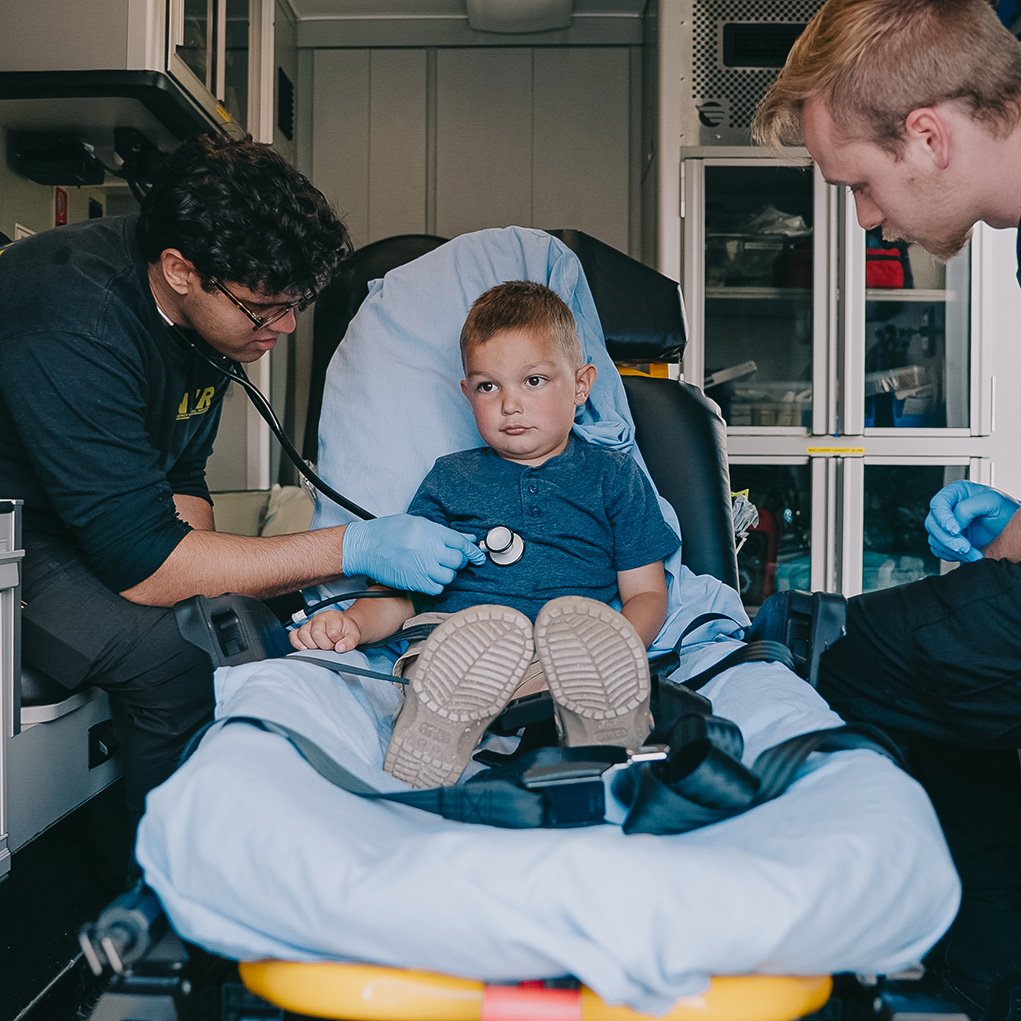
Choking gives you seconds, not minutes. How to help an adult, a child, or a baby with a blocked airway, and what to do if they stop responding.
A family dinner in Loves Park. Somebody laughs mid-bite, then stops talking. They are still upright, still at the table, but their hands are at their throat and their face is changing color. Half the room freezes because everyone assumes someone else knows what to do. Choking gives you seconds, not minutes.
Knowing how to help someone choking is one of the most useful skills a person without medical training can carry. An ambulance takes time to arrive, and a blocked airway does not wait for it. The people who make the difference are usually already in the room.
Our crews at Northwest Rescue respond to airway emergencies across northern Illinois and southern Wisconsin, in restaurants, nursing homes, schools, and living rooms. What separates good outcomes from bad ones is usually how fast a bystander recognized a severe obstruction and acted. The right action differs for an adult, a child, and a baby, so this guide walks through all three, plus what to do when the person stops responding. It is educational and doesn't replace a certified hands-on first aid and CPR course. In any choking emergency, call 911.
Is it mild or severe choking?
Every step below starts with this decision.
With a mild obstruction, the person can still cough forcefully, speak, or cry. Air is moving, and a strong cough generates more pressure than your hands can. Encourage them to keep coughing. Don't slap their back, give thrusts, or hand them water. Stay close and watch, because mild can turn severe in seconds.
A severe obstruction means air is barely moving or not moving at all. You'll see a weak or absent cough, no ability to speak or cry, squeaking or silence, skin turning blue or gray, confusion, or hands clutched at the throat. Someone silent and struggling needs help now. Have someone call 911 while you begin. If you're alone, put the phone on speaker and start.
How to help someone choking: adults
For a responsive adult with a severe obstruction, current American Heart Association guidance calls for alternating cycles that start with back blows. The Red Cross has taught it this way for years, so the five-and-five sequence is now consistent across the major training organizations. If you learned abdominal thrusts only, this is the update to carry forward.
- Stand to the side and slightly behind the person. Support their chest with one hand and lean them forward at the waist.
- Give 5 back blows. Strike firmly between the shoulder blades with the heel of your hand. Each blow is a separate attempt to dislodge the object, not part of a rhythm.
- Move behind them and give 5 abdominal thrusts. Wrap your arms around their waist and make a fist, thumb side just above the navel and well below the breastbone. Grasp it with your other hand and pull sharply inward and upward.
- Repeat cycles of 5 and 5 until the object comes out, they can speak, or they become unresponsive.
If the person is in late pregnancy, or you can't get your arms around their waist, use 5 chest thrusts in place of the abdominal thrusts. Put your hands on the center of the breastbone and pull straight back with the same firm, quick motion. The count and the cycle stay the same.
For someone in a wheelchair, kneel behind them or work from the side, moving an armrest if you need to. The technique doesn't change.
If you're the one choking and you're alone, call 911 even if you can't speak, because an open line gets help moving. Then thrust your own fist above your navel, or press your upper abdomen hard against a firm edge like a sturdy chair back.
What changes for children over one
The protocol for a child is the same as for an adult: alternating cycles of 5 back blows and 5 abdominal thrusts, starting with back blows, until the object clears or the child goes unresponsive.
The differences are practical. Kneel so you're at the child's level instead of lifting them off the ground. Scale your force to their size, but not so gently that the thrusts do nothing. Keep your hands above the navel and clear of the ribs. Children also panic and run, so if one bolts, follow and keep working.
Choking infants under one year
Learn this section before you ever need it. Never give abdominal thrusts to an infant. A baby's liver sits low with little protection from the rib cage, and thrusts can cause serious internal injury. Infants get back blows and chest thrusts instead.
- Lay the baby face down along your forearm. Support the jaw and head with your hand, keep the head lower than the chest, and brace your forearm on your thigh.
- Give 5 back blows with the heel of your free hand between the shoulder blades.
- Turn the baby face up, sandwiched between your forearms so the head stays supported and lower than the chest.
- Give 5 chest thrusts. Place two fingers on the lower half of the breastbone, just below the nipple line, and push down quickly five times, about an inch and a half deep.
- Repeat cycles of 5 and 5 until the baby coughs or cries, or becomes unresponsive.
Look in the mouth between cycles. If you see the object, remove it. If you don't, keep going.
One 2025 change to know about: for infant CPR compressions, the AHA now recommends the two-thumb encircling technique or the heel of one hand rather than two fingers. That applies to CPR, not to the chest thrusts above.
When the person stops responding
This is the moment most people freeze, and it's where the steps change.
- Lower them carefully to a firm, flat surface. Don't let them fall.
- Make sure 911 has been called and that someone brings the AED if one is nearby.
- Start CPR, beginning with chest compressions. Compressions raise pressure in the chest and can move the object on their own.
- Before each set of breaths, open the mouth and look. If you see the object, hook it out with a finger. If you don't see anything, close the mouth and go back to compressions.
- Keep going with CPR until the airway clears or EMS takes over.
If you're untrained or unwilling to give breaths, do continuous compressions. Our hands-only CPR guide covers rate, depth, and hand placement.
Common mistakes that make choking worse
The most dangerous one is the blind finger sweep. Reaching into the mouth hoping to find something pushes objects deeper, can wedge them past retrieval, and risks getting bitten. Remove only what you can see.
Don't slap the back of someone who is coughing forcefully. A strong cough is doing its job, and interrupting it can shift the object into a worse position. Water won't wash a solid obstruction down either, and holding a baby upside down by the ankles is a folk remedy, not a technique.
Finally, don't drive someone to the hospital instead of calling. A person who just stopped choking can get worse in the car. Our guide on when to call 911 versus driving to the ER explains why.
After the object comes out
The emergency isn't over when the airway clears. Thrusts generate real force. They can bruise organs and crack ribs, and adrenaline hides the pain at the scene. Anyone who received thrusts should be evaluated, and anyone who lost consciousness needs transport.
Watch for a persistent cough, noisy breathing, drooling, trouble swallowing, chest pain, or vomiting afterward. Those can point to a fragment still in the airway, a piece that traveled into a lung and causes trouble hours or days later, or an injury from the rescue itself.
For infants and children, keep the threshold low. Small airways swell fast, and a child who looks fine can worsen. Northwest Rescue runs a dedicated pediatric and neonatal transport service alongside 911 emergency response from our stations in Loves Park, Rockford, Harvard, Lake in the Hills, and Delavan.
Frequently asked questions
How can you tell if someone is really choking?
The clearest sign is a person who suddenly can't speak, cough forcefully, or cry while eating or with a small object nearby. Panic on the face, a high-pitched squeak, and pale skin are common. Someone coughing loudly and talking in full sentences has a mild obstruction and should keep coughing. If you aren't sure, ask them, and if they can't answer, start back blows.
Should I call 911 even if the object came out?
Usually, yes. Anyone who received thrusts, lost consciousness, or is still coughing, drooling, or breathing noisily should be checked, and children warrant a lower threshold. Call 911 rather than driving them yourself. If the airway closes again on the way, a crew can manage it, while a family member behind the wheel cannot.
Related reading
- Hands-Only CPR: A Step-by-Step Guide
- When to Call 911 vs. Drive to the ER
- AED Basics for Illinois Businesses and Community Spaces
- Pediatric and Neonatal Transport: Why a Specialized Team Matters
- Anaphylaxis Response: How and When to Use an EpiPen (coming soon)
The people who save choking patients are rarely the ones who read about it once. Take a certified first aid and CPR course, then practice the infant sequence until your hands remember it. Northwest Rescue has served Northern Illinois and Southern Wisconsin since 2013, from stations in Harvard, Rockford, Loves Park, Lake in the Hills, and Delavan. To talk through standby coverage for your school, facility, or event, contact our team.