
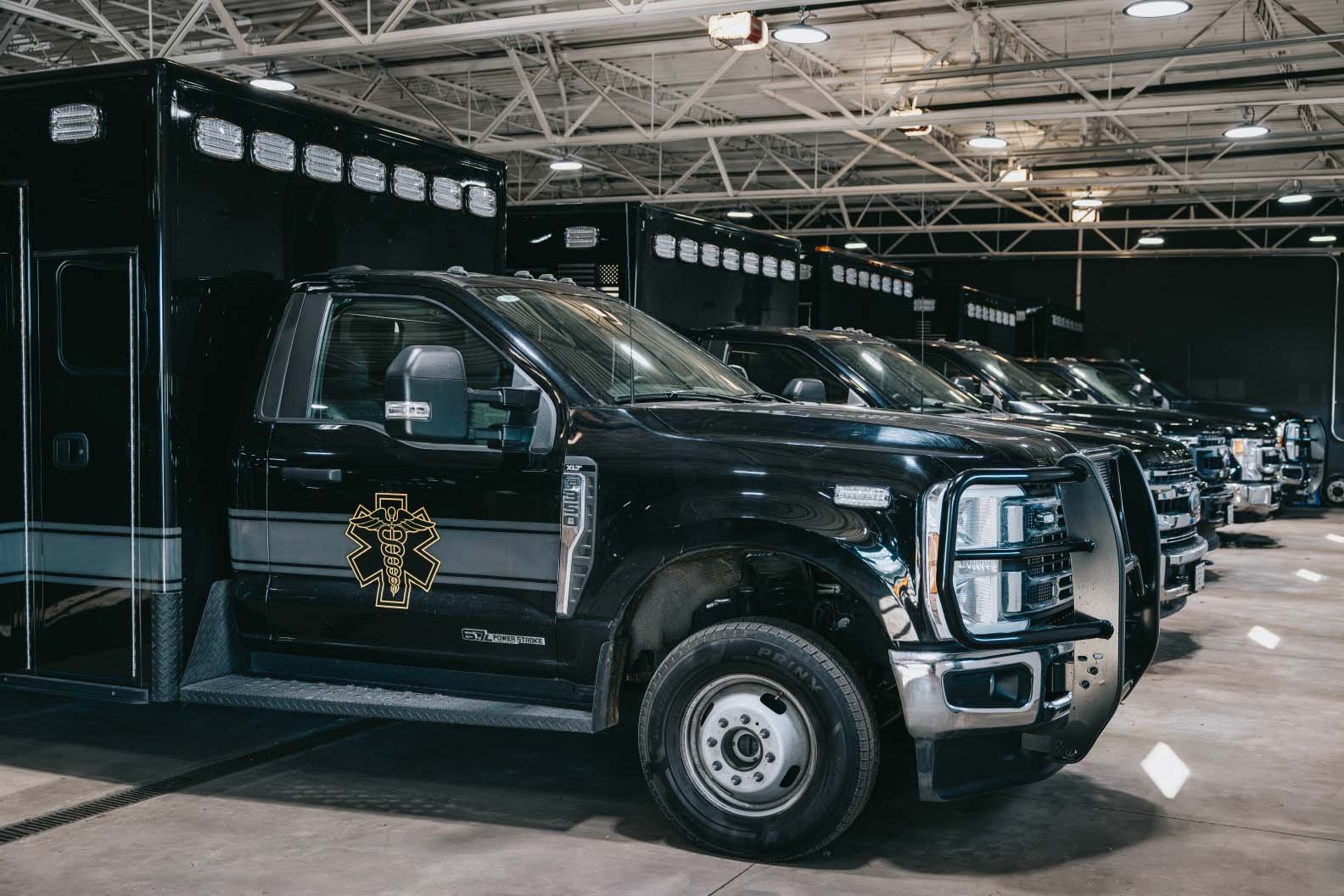
A look inside the Northwest Rescue fleet: BLS, ALS, and Critical Care rigs, what each carries, and how we choose which one responds.
A dialysis patient waiting by the door at 6 a.m. and a man with crushing chest pain on his kitchen floor both need an ambulance, but they don't need the same one. What pulls up depends on who the patient is and what could go wrong on the way to the hospital. This is a look inside the Northwest Rescue fleet: what we run, what each rig carries, and how we decide which one goes where.
We run a mixed fleet from our six stations across northern Illinois and southern Wisconsin. Each type of vehicle has its own job, its own crew setup and its own inventory of medical equipment. Which one a call gets comes down to how sick the patient is, whether the trip is an emergency or planned in advance, how far it has to go, and now and then the terrain.
Basic life support ambulances
The BLS unit is the workhorse of any EMS system. It handles most non-emergency transports and the lower-acuity 911 calls, and it is staffed by two EMTs. You can read more about how we use it on our Basic Life Support service page.
A BLS rig carries oxygen and the basic airway tools: nasal cannulas, non-rebreather masks, a bag-valve mask, and oral and nasal airways. It has an AED for CPR and cardiac arrest, a stretcher and stair chair for moving patients, and trauma supplies for splinting, bleeding control and c-spine immobilization. Crews can check blood pressure, pulse oximetry and blood glucose. The medication kit is small on purpose: oral glucose, aspirin, a naloxone auto-injector, an epinephrine auto-injector, and help with a patient's own prescribed inhaler or nitroglycerin when it's indicated.
Typical BLS work is a stable hospital discharge, a dialysis run, an interfacility transport where the patient doesn't need a paramedic, or a 911 call where dispatch triage shows BLS is enough. If you're trying to decide which level a patient needs, our ALS vs BLS ambulance guide walks through it.
Advanced life support ambulances
On most modern EMS systems, the ALS unit is the standard 911 rig. It carries at least one paramedic paired with an EMT, and it has everything a BLS unit has plus a good deal more. Our Advanced Life Support page covers the service itself.
The biggest addition is the cardiac monitor. It reads a 12-lead ECG and can transmit it to the receiving hospital before the patient arrives. The same monitor works as a manual defibrillator and can do synchronized cardioversion and transcutaneous pacing. ALS crews start IV and IO lines, run IV pumps, and carry a much larger drug box with cardiac drugs, anti-arrhythmics, vasopressors, sedatives, pain control, anti-nausea and seizure medications, and dextrose for low blood sugar. The airway kit steps up too, with endotracheal intubation supplies, supraglottic airways such as the i-gel and King airway, and backups for a difficult airway. There's also CPAP for patients in respiratory distress.
That kit is why ALS goes to chest pain, trouble breathing, altered mental status, seizures, stroke symptoms, major trauma, and any 911 call where the patient could get worse. It also covers higher-acuity interfacility transfers where someone needs medications managed or a paramedic's assessment on the way.
Critical care transport units
Some patients are too sick for a standard ALS rig. They're on a ventilator, they have several drips running, or they have an arterial line that someone needs to watch for the whole drive. For them we send a critical care transport unit, staffed by a Critical Care Paramedic or Critical Care Nurse with a paramedic driving.
A CCT rig carries a transport ventilator that can match hospital ICU settings, including PEEP and different vent modes. It has four to six IV pumps so the crew can manage vasopressors, sedatives and anti-arrhythmics at the same time. Crews can run invasive monitoring through arterial lines and central venous pressure, along with capnography. The airway kit adds video laryngoscopy and surgical airway supplies, and some services carry blood products as well.
These units handle the highest-acuity interfacility transfers. That means moving ICU patients from community hospitals to tertiary centers like trauma centers, stroke centers and cardiac cath labs, along with post-cardiac arrest patients and complex specialty transfers. Our guide to what critical care transport is goes deeper on when a patient needs this level.
Pediatric and neonatal transfers
Children and newborns are a special case. Most of these transfers are run with the receiving children's hospital's own specialty team, a pediatric or neonatal ICU crew that brings age-specific equipment: an isolette for newborns, ventilator settings for small patients, and drug doses calculated by weight. When that team needs a partner rig, we provide the ambulance, the driver and support crew, and we work closely with them on the transfer.
Our pediatric and neonatal transport guide explains why the specialized team approach matters for these patients and how the coordination works.
Vehicles that don't carry patients
Not every EMS vehicle is a full ambulance. Shift supervisors and quality assurance officers drive their own vehicles and respond alongside ambulances on high-acuity calls. They back up the crew, coordinate when several agencies are on scene, handle scene logistics, and carry extra supplies for whichever ambulance is there. Many systems also run event standby and community response vehicles for events and outreach, set up as bike medic units, small utility vehicles or side-by-sides that can reach places a truck can't.
Wheelchair vans are a separate category. They're for patients who need a ride but don't need an ambulance stretcher or clinical monitoring, and they are legally distinct from ambulance transport, with different licensing, different billing and different insurance coverage.
How we choose which rig responds
On a 911 call, dispatch triage software matches the call type and acuity to the nearest unit with the right staffing. Chest pain gets ALS if an ALS unit is available. A stable discharge home gets BLS. A high-acuity ICU transfer gets CCT. The dispatcher works from a matrix of call types and the units that are free.
Planned transfers start with the sending hospital. Its case management team tells us the level of care the patient needs, and our dispatch confirms the details with the facility, including the patient's condition and what has to happen on the way. Sometimes what we hear changes the answer, in either direction. If a "BLS" request turns out to be a patient on IV drips, we send ALS or CCT instead, and if things change en route, the crew or a supervisor can upgrade the response. When the picture is unclear, we would rather send more care than the patient turns out to need.
Keeping the Northwest Rescue fleet ready
An ambulance that hasn't been checked and stocked at the start of a shift can't be sent on a call, so every rig in our fleet runs on the same cycle:
- Start of every shift: the crew inventories medications and expiration dates, checks that the equipment works, verifies oxygen tank levels, tests the defibrillator, checks the IV pumps, and confirms fuel and cleanliness. It takes 30 to 45 minutes, and the crew isn't available for calls until it's done.
- Weekly: a deeper inventory with medication rotation and restocking, a deep clean of high-touch surfaces, biohazard bag rotation and a vehicle systems check.
- Preventive maintenance: fleet mechanics service each rig on a mileage and hours schedule, covering oil changes, brakes, transmission and drivetrain. High-mileage ambulances are checked more often.
- Between calls: after any transport where clinical supplies were used, the rig is cleaned and restocked and biohazards are handled before the crew calls in available.
Any rig with a problem that could affect patient care comes out of service until it's repaired. That routine is a big part of what makes response times reliable, because the whole system depends on every truck being ready when it's called.
Why we run multiple stations
A single station can serve a small area well, but calls at the edges of its area wait a long time. Spreading stations out, based on call volume, the road network and mutual aid patterns, brings average response times down substantially. That's why we work from several stations, from Loves Park and Rockford out to Harvard and up to Delavan, Wisconsin.
Our article on why we serve northern Illinois and southern Wisconsin explains the thinking behind where our stations sit.
Frequently asked questions
How many ambulances does Northwest Rescue have?
The number varies by station and by shift, and the overall mix changes as we retire older rigs and bring new ones into service. Our fleet includes BLS units, ALS units, critical care transport rigs and supervisor vehicles. Current counts and station assignments are posted on our fleet page, which we update as vehicles come into and out of service.
Do you have a helicopter?
No. Northwest Rescue is a ground ambulance service and doesn't operate helicopter EMS. When a patient is time-critical and helicopter transport is clinically appropriate, we coordinate with the regional air medical services, such as Flight for Life and LifeLine depending on the mission, and our ground crew hands care off to the flight team.
Related reading
- Why We Serve Northern Illinois and Southern Wisconsin
- 911 vs. Interfacility Transport: What's the Difference and When Do You Need Each?
- Pediatric and Neonatal Transport: Why a Specialized Team Matters
- ALS vs BLS Ambulance: When Each Is the Right Call
- What Is Critical Care Transport? (And When You Need It)
Want to see the current NWR fleet up close? Our About Us / Our Fleet page has vehicle photos and station assignments. For non-emergency transport bookings or event standby requests, our team is available 24/7.