
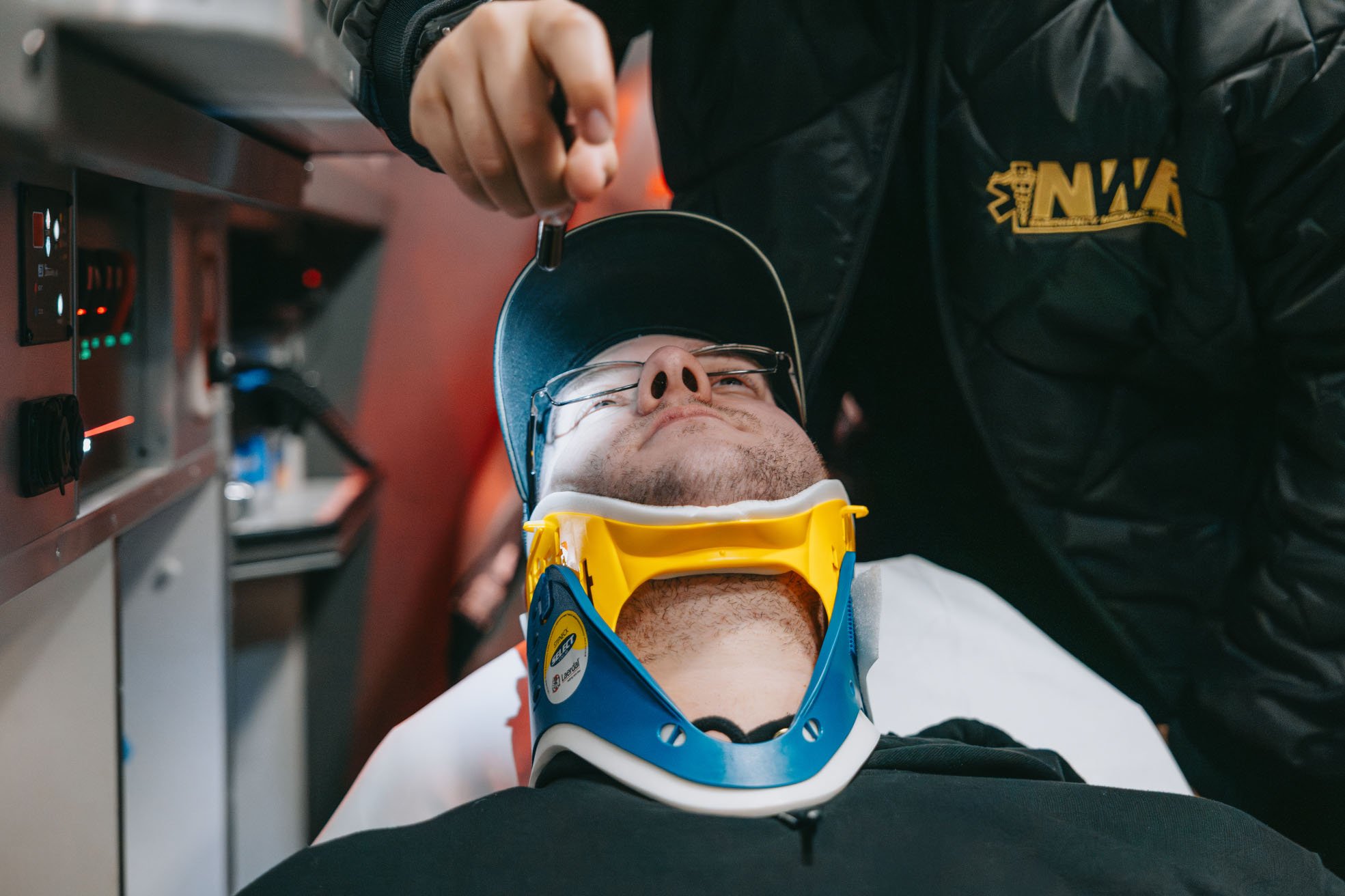
Any BE FAST sign coming on suddenly means call 911. What balance, eyes, face, arms, speech, and time each mean — and exactly what to do next.
Someone at the family cookout suddenly seems off — their smile is lopsided, they're slurring their words when they try to answer a question, and when you ask them to raise both arms, only one goes up. Is it low blood sugar? A weird moment? Or is it something that needs 911 right now?
Quick answer: BE FAST stands for Balance, Eyes, Face, Arms, Speech and Time. If someone suddenly loses their balance, has trouble seeing, has a drooping face, a weak arm or slurred speech, call 911 immediately. Every minute without treatment matters.
If any of those signs appear, treat it as a stroke until proven otherwise. Every minute a stroke goes untreated, roughly 1.9 million brain cells die. The window for the most effective clot-busting treatments closes fast — often within 3-4.5 hours from symptom onset. That's why recognizing a stroke quickly and getting the person to the hospital fast is one of the single most impactful things a bystander can do.
This guide walks through the BE FAST method for recognizing a stroke — the same recognition framework paramedics use in the field — plus what to do (and what not to do) once you recognize the signs.
What BE FAST Stands For
BE FAST is the expanded version of the older FAST acronym, adding two additional signs (Balance and Eyes) that catch strokes the original FAST test misses. It's the mnemonic taught by the American Stroke Association, hospital stroke teams, and most modern EMS training programs.
- B — Balance: Sudden loss of balance or coordination. The person might stumble, feel dizzy, or have trouble walking straight for no clear reason.
- E — Eyes: Sudden vision changes. Double vision, loss of vision in one or both eyes, or a sudden visual disturbance that comes out of nowhere.
- F — Face: Sudden facial drooping, usually on one side. Ask the person to smile. If one side of the mouth doesn't move up the way the other side does, that's facial droop.
- A — Arms: Sudden weakness in one arm. Ask the person to raise both arms in front of them and hold them there. If one arm drifts down or can't come up at all, that's arm weakness.
- S — Speech: Sudden slurred speech or trouble finding words. Ask a simple question ("What's your name? Where are you?"). Listen for slurring, garbled words, or an inability to answer coherently.
- T — Time: Time is critical. Call 911 immediately if any of the above are present. Note the time symptoms started — the ER team will ask, because it determines which treatments are on the table.
Not every stroke shows all six signs. Any one of them, coming on suddenly, is enough to justify a 911 call. If you notice more than one, the likelihood the person is having a stroke goes way up.
Why "Sudden" Is the Key Word
Stroke symptoms come on suddenly. That's what separates them from most other conditions.
- A slowly-worsening headache over days is usually not a stroke.
- Facial droop that developed over months is usually not a stroke (though it should still be evaluated).
- Chronic balance issues in someone with vertigo or inner ear problems are usually not a new stroke.
But sudden onset — minutes, not hours — of any of the BE FAST signs is a red-alert scenario. The word "sudden" is the diagnostic tell that a stroke team will listen for when you call.
What to Do the Moment You Notice Signs
Once you recognize any BE FAST sign appearing suddenly, the sequence is:
- Call 911 immediately. Not urgent care. Not a family doctor. Not "let's watch and see." 911. Ambulance crews carry the equipment and hospital communication tools to route the patient to a stroke-capable center, not just the closest ER — a huge difference in outcomes.
- Note the time symptoms started. If you didn't witness the onset, ask when the person was last known to be normal. The ER team makes treatment decisions based on this number.
- Do NOT give the person food, water, or medication. Stroke can affect swallowing, and aspirated fluids or pills cause dangerous complications. This includes aspirin — even though aspirin is right for a suspected heart attack, it's wrong for stroke because stroke can be either ischemic (clot) or hemorrhagic (bleed), and aspirin makes a bleed worse.
- Stay with the person and reassure them. Don't leave them alone. Many stroke patients are frightened or confused; a calm presence matters.
- Note any medications the person is on — especially blood thinners (warfarin, Eliquis, Xarelto, aspirin, Plavix). Tell the paramedics when they arrive. Blood thinners change the treatment path significantly.
- Clear a path for the ambulance crew. Move furniture, unlock the front door, turn on porch lights at night.
- If the person becomes unresponsive and stops breathing normally, begin CPR. Our Hands-Only CPR guide walks through the technique. If an AED is available, use it — our AED Basics guide covers the basics.
Why Time Matters So Much
The most effective stroke treatments have narrow windows:
- tPA (a clot-busting IV medication): The window is 3 hours from symptom onset for most patients, extending to 4.5 hours in some eligible cases. Given after that window, tPA no longer works and the risks outweigh the benefits.
- Mechanical thrombectomy (a catheter-based procedure that pulls out the clot): The window extends to 24 hours in some patients based on brain imaging, but earlier is dramatically better. Patients treated within 6 hours have significantly better outcomes than those treated at 12+ hours.
- Neither treatment applies to hemorrhagic strokes (about 15% of strokes), which are caused by a bleed rather than a clot. Those get different management — but still time-critical.
The single biggest predictor of stroke recovery is time from symptom onset to treatment. That's why the "call 911, don't drive" advice matters — the ambulance crew starts the clock on hospital notification the moment they arrive, and can activate the stroke team before the patient rolls through the ER doors.
For the general framework on when 911 vs driving to the ER is right, our When to Call 911 vs. Drive to the ER guide covers the decision. Stroke is one of the clearest 911-only scenarios — never drive a suspected stroke patient yourself.
What Happens During the Ambulance Ride
If you call 911 for a suspected stroke in northern Illinois, the ambulance response is coordinated:
- The 911 dispatcher will pre-alert the crew that this is a suspected stroke, so they arrive prepared.
- On scene, the paramedics run their own BE FAST-style assessment (usually the Cincinnati Prehospital Stroke Scale or a similar validated tool) to confirm the suspicion.
- They'll check blood sugar to rule out hypoglycemia, which can mimic stroke.
- They'll get a 12-lead ECG to check for atrial fibrillation (a common stroke cause).
- They'll notify the receiving hospital while en route, activating the stroke team before arrival.
- They'll route to a Primary Stroke Center or Comprehensive Stroke Center if one is within reasonable transport time — these hospitals have dedicated stroke teams and can perform thrombectomy. In northern Illinois, that means transport to Rockford, Chicago-area, or Peoria stroke centers depending on where you are.
- For very complex cases, transfer to a Comprehensive Stroke Center happens after initial ER evaluation. Our What Is Critical Care Transport guide covers how these inter-hospital transfers work.
Common Stroke Mimics — Things That Look Like Stroke But Aren't
Not everything that presents with sudden neurologic symptoms is actually a stroke. Common mimics include:
- Hypoglycemia (low blood sugar) — can cause confusion, weakness, and even one-sided symptoms in diabetics. Paramedics check blood sugar first for exactly this reason.
- Migraine with aura — can cause visual disturbances, one-sided weakness, and speech problems. Usually shorter-lived than stroke, but on presentation it can look identical.
- Seizure (postictal state) — after a seizure, patients can have transient weakness or confusion that mimics stroke.
- Bell's palsy — a facial nerve issue that causes one-sided facial droop, but without the arm weakness or speech problems.
- Complicated migraine or hemiplegic migraine — rare, but can present with symptoms indistinguishable from stroke on first look.
The takeaway: don't try to sort mimics from real strokes yourself. Call 911. The ER team has imaging, labs, and neurologists who can make that call — you shouldn't. Being wrong about "just a migraine" costs someone their brain function.
Frequently Asked Questions
What Does BE FAST Stand For?
BE FAST is an expanded stroke recognition tool: Balance (sudden loss of balance or coordination), Eyes (sudden vision changes), Face (sudden facial drooping, usually one-sided), Arms (sudden weakness in one arm), Speech (sudden slurred speech or difficulty finding words), and Time (time to call 911 immediately). It's the recognition framework taught by the American Stroke Association and used by EMS crews across the country. It expands on the older FAST test by adding balance and eyes, which catches strokes that the original FAST missed.
Should I Drive Someone Having a Stroke to the ER Myself?
No. Call 911. An ambulance crew can pre-notify the receiving stroke center, activate the stroke team before arrival, run initial assessments and IV access en route, and route to the closest hospital with the right stroke capabilities (not just the closest ER). Driving yourself skips all of that and delays treatment. The clot-busting medication tPA has a 3-4.5 hour window from symptom onset — every minute of delay affects outcomes and recovery.
What Should I Not Do If Someone Is Having a Stroke?
Don't give them food, water, or medication (including aspirin — even though aspirin is right for suspected heart attack, it's dangerous for stroke because 15% of strokes are bleeds, and aspirin makes bleeds worse). Don't leave them alone. Don't wait to "see if it gets better." Don't drive them to the ER yourself. Don't let them fall asleep unattended — stroke patients can deteriorate quickly, and someone needs to be actively watching for changes.
How Long Does It Take for Stroke Symptoms to Show?
Stroke symptoms typically appear suddenly — within minutes, not hours. That sudden onset is one of the diagnostic tells. Symptoms that develop gradually over days or weeks are usually not stroke (though they still warrant medical evaluation). If BE FAST signs appear suddenly and are present at the same time, treat it as stroke and call 911 immediately.
Can a Stroke Happen Without Pain?
Yes — most strokes are not painful. Only certain types of hemorrhagic strokes (particularly subarachnoid hemorrhage from a burst aneurysm) cause a severe, sudden "thunderclap" headache. Most ischemic strokes (about 85% of strokes, caused by a clot) cause the BE FAST symptoms without significant pain. Because strokes don't hurt the way a heart attack does, they're often ignored or delayed until symptoms get so severe someone else notices. That's why the BE FAST framework matters — it's a checklist that catches strokes even without pain.
What's the Difference Between a Stroke and a TIA?
A transient ischemic attack (TIA), sometimes called a "mini-stroke," produces BE FAST-style symptoms that resolve completely within minutes to hours without lasting damage. TIAs are caused by a temporary clot that dissolves on its own. They're a serious warning sign — about 15-20% of people who have a TIA go on to have a full stroke within 90 days, most within the first few days. Every TIA needs immediate emergency evaluation, even if symptoms are already gone. Never treat a TIA as "just a scare" — the full stroke often follows.
Does Northwest Rescue Handle Stroke Calls?
Yes. Northwest Rescue's ALS crews respond to suspected stroke calls across northern Illinois. Our paramedics are trained in prehospital stroke assessment, ECG interpretation, and stroke center routing — meaning we don't just transport to the closest ER, we route to the stroke-capable center best positioned to treat the patient. For higher-acuity transfers between community hospitals and Comprehensive Stroke Centers, our Critical Care Transport service handles the ride while maintaining ICU-level care en route.
Related reading
- When to Call 911 vs. When to Drive to the ER: A Practical Guide
- How to Perform Hands-Only CPR: A Simple Guide from Professional Medics
- AED Basics: What Every Illinois Business and Community Space Should Know
- Heart Attack vs. Panic Attack: How to Tell the Difference
- When to Use a Tourniquet: A Bleeding Emergency Guide (coming soon)
Every minute a stroke goes untreated, brain cells die. If you or someone near you shows any BE FAST sign coming on suddenly, call 911 immediately — Northwest Rescue is on call 24/7 across northern Illinois. Note the time symptoms started, don't give food or medications, and stay with the person until help arrives.